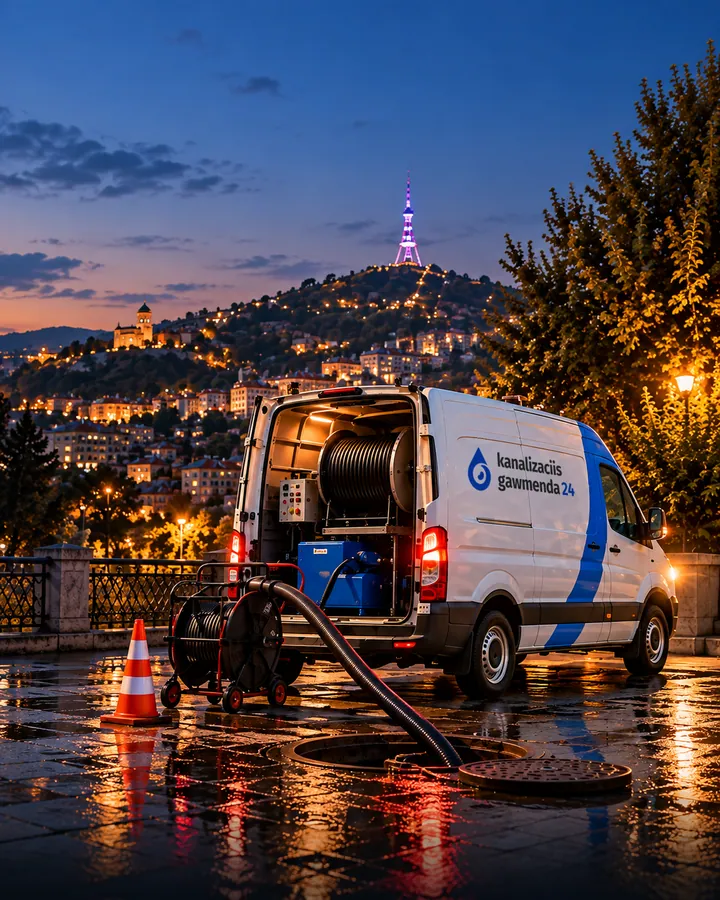
Clearing a blockage in Tbilisi costs from 150–200 ₾: a sink, kitchen sink or bathtub — 200 ₾, a toilet — 250 ₾, the apartment pipe — 350 ₾, the shared riser by cable — 350 ₾. These are prices for a standard job in the daytime, with everything the work needs. Below: what the price depends on, why “from 50 ₾” in ads is not a price, and how not to overpay.
What drain cleaning costs now
Here are the jobs people ask about most. Each line is the price of the whole job in the daytime: the visit, a cable of the right diameter and a drain test after cleaning. In the evening and at night a percentage is added — more on that below.
| Sink, kitchen sink or bathtub | 200 ₾ |
|---|---|
| Toilet | 250 ₾ |
| Apartment pipe up to the shared riser | 350 ₾ |
| Shared riser by cable | 350 ₾ |
| Hydro jetting | 50 ₾/m |
| Inspection visit — counts towards the work | 70 ₾ |
The full table — with well pumping, rodding and grease traps — is on the drain cleaning prices page.
What the price includes and what it doesn’t
The price of a standard job includes everything the cleaning can’t be done without: the visit anywhere in Tbilisi, a cable of the right diameter or a jetting machine, the work itself, a water test of the drain afterwards and a photo report — what we pulled out and where the blockage was. We charge nothing extra for any of this.
It doesn’t include work that is no longer cleaning: removing and refitting a toilet, opening a boxed-in pipe, replacing a cracked trap, a corrugated hose or a section of pipe. Parts, if needed, we buy with a receipt or fit yours. The technician tells you all this before starting and does nothing extra without your consent.
What the price depends on
Five things set the price. We ask about each on the phone — that is why we quote before the visit, not on site.
Where the blockage is
A blockage in the trap of a single sink is the shortest job: the technician removes the trap or runs the cable a metre or two. If water stands in the bathtub and in the kitchen at once, the blockage is further — in the apartment pipe — and a longer cable is needed. If water rises when the neighbours drain theirs, the blockage is in the shared riser: the work goes through a cleanout on another floor or from the basement. The further the blockage, the longer the cable and the longer the job. How to tell where yours is — on the apartment blockage and central riser pages.
The method
Cable cleaning has a fixed price per point: a sink, a toilet and the shared riser each have their own price for the whole job. Hydro jetting and rodding are charged per metre: hydro jetting — 50 ₾ per metre, rodding — 30 ₾ per metre. Well pumping — per cubic metre. Per metre is fairer: a 15 m pipe and an 80 m pipe are different jobs, and one price for both would mean someone overpays. The technician names the length before starting. When pressurised water is needed and how it differs from a cable — on the hydro jetting page.
Time of day
In the daytime (9–18) — the price from the table. In the evening (18–22) 25% is added, at night (22–9) — 50%. Weekends and holidays are like weekdays. We round the total down to 10 ₾. If the water just drains slowly and floods nothing, it pays to wait until morning. If it is at the rim or already on the floor, don’t wait: when to call at once is on the emergency call-out page.
Access
Sometimes the pipe can’t be reached without extra work: removing and refitting a toilet, opening a boxing or tiles at a cleanout. That is a separate job, and the technician names its price before starting — we do it only with your consent. Without consent we work through the access there is and tell you honestly what will come of it.
Distance
Anywhere in Tbilisi the visit has no surcharge: Gldani and Vake cost the same. To Rustavi, Mtskheta and other nearby towns we come for a travel fee, which we name together with the price of the work.
How we quote on the phone
To quote before the visit, five questions are enough: where the water stands — at one point or several; whether it rises when the neighbours drain theirs; which floor and what building — old with cast-iron pipes or new with plastic; what you have already tried; whether the pipe can be reached without dismantling anything. The answers show where the blockage is and what method is needed — and the price is clear.
If the picture doesn’t come together on the phone — for example, water drains, but slowly and with a smell through the whole building — we offer an inspection visit for 70 ₾. That money counts towards the work if you order it.
Why “from 50 ₾” is not a price
Drain cleaning ads often say “from 50 ₾”. It isn’t a lie in the plain sense, but it isn’t a price either. The scheme is simple and worth knowing, whoever you call.
“From” is the price of the simplest case, which almost never happens: a blockage in the trap that is visible at once and needs no tools. On a real call, lines get added on site: “cable extra”, “difficult blockage”, “call-out extra”, “night rate”. Each sounds reasonable; together they make a sum several times the promised one.
You can spot the bait in an ad in advance. The price has no unit — it is unclear what it is for: the visit, a metre or the job. Not a word about evenings and nights. No list of what is included. And almost always “from”, not a total.
The scheme works because arguing on site is hard. The technician is already in the apartment, the water stands, and finding someone else and waiting another hour is worse than agreeing. People pay not because the price is fair, but because there is no choice left.
Why does nobody work for less than 150–200 ₾? Count it yourself: a drive across a city with traffic — up to an hour each way, an electric cable and its wear, an hour of the technician’s work, a drain test. That is the real cost, and “50 ₾” doesn’t cover it. So the shortfall will show up on the bill later — as extras.
We publish the full price of a standard job, without “from”, and name it before the visit. If on site the case turns out not to be standard, the technician says so before starting, and the price changes only with your consent.
Five questions to ask on the phone
It doesn’t matter whom you call — us or others. These five questions separate a price from bait:
- What does the whole job cost — not “from”, but the total?
- What is included — the visit, the cable, the drain test?
- Can the price change on site, and in what case?
- How much will it be in the evening or at night?
- Is there a guarantee if the blockage comes back?
We answer all five before the visit and send the price in writing on WhatsApp, so there is no “that’s not what we agreed” on site. The guarantee is 3 days: if the blockage comes back, we come and clear it free of charge.
Who pays for the shared riser
The shared riser is the building’s pipe, not the apartment’s, but residents pay for cleaning it. Neighbours usually agree like this: the floor with the blockage and every floor above pay — their waste water created the blockage. The sum is split equally, and to avoid arguments the technician sends a photo report: what came out of the riser and at what level. The price of the riser by cable is 350 ₾ for the whole job, however many apartments pay. How to agree with the neighbours — on the central riser page.
Calculation examples
Three typical cases from our price list. These are calculation examples, not stories of specific orders: real cases with photos will appear here after our first jobs.
- Calculation example
A toilet clogged on a Saturday afternoon
250 ₾
Weekends are like weekdays: the daytime price, nothing extra for the day of the week.
- Calculation example
The shared riser at 23:00
520 ₾
At night (22–9) 50% is added to 350 ₾, and we round the total down to 10 ₾. The sum is shared by everyone who pays.
- Calculation example
Outside pipe of a private house, 15 m, daytime
750 ₾
Hydro jetting is charged per metre: 15 m at 50 ₾ per metre.